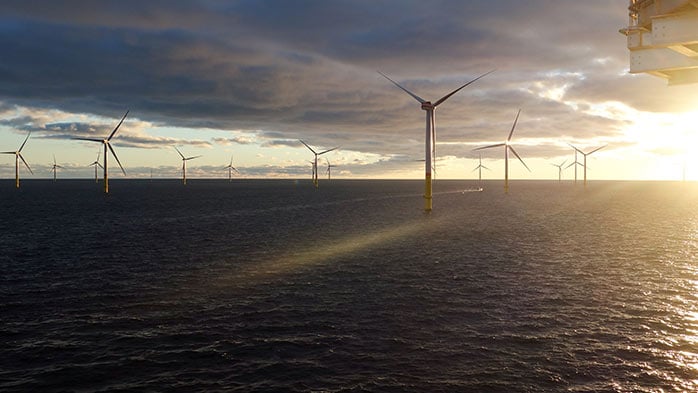
The subsea cable sector has grown exponentially in recent years as offshore wind has risen in significance from clean, renewable energy to a cornerstone of countries’ energy autonomy. Subsea cable demand is forecast to grow at a 19% CAGR to 2030 and cable supply could become a key bottleneck of the energy transition.
2025 was a landmark year for offshore wind, with significant capacity growth, new project announcement and technological advancement. The landscape of offshore wind was relatively positive with major project development especially in Europe and China. At the same time, significant policy shifts in the United States have introduced a period of uncertainty for developers and investors.
Europe continues the momentum with an offshore wind development programme
A major Western European player, the United Kingdom accounts for 28% of global subsea cable demand. The UK recorded a record high share of electricity generated by wind in December 2025, with around 47% coming from onshore and offshore wind farms. Sumitomo Electric Industries was recently confirmed to be contracted to supply and install subsea high-voltage direct current (HVDC) cables for the Sea Link Project as part of the Great Grid Upgrade effort to support the nation’s net-zero targets.
The Crown Estate has announced a further grant of £13 million to 16 offshore wind supply chain projects as part of the Supply Chain Accelerator programme. The programme was established in 2024 to support the capacity and capability of the UK supply chain in the offshore wind industry.
However, one of the setbacks faced by the UK offshore wind industry is the announcement of the discontinuation of phase 4 of the Hornsea project, which was set to become the largest offshore wind farm in the world. The developer, Orsted, cited that this cancellation is mainly due to higher costs and rising interest rates.
Separately, the European Investment Bank approved a €500 million to Iberdrola to develop an offshore wind farm project in the German Baltic Sea. This project aims to support the electrification of Germany’s grid and expecting to go into full commissioning by late 2026.
Floating wind is also on the rise, leading by Norway with approvals of two floating wind projects at Utsira Nord in the North Sea. The UK has also started to move its way into floating wind, with Ocean Winds set to build one of the first commercial floating wind farms in the UK.
China offshore wind advances with technological innovation
China continues to push offshore wind development and technology innovation in 2025. China currently accounts for 27% of global subsea cable demand. One of the notable projects is the construction of Yangjiang Fanshi-2 offshore wind farm in Guangdong province by CGN Wind Energy Limited. ZTT Submarine Cable & System, which won the EPC contract in April, has delivered the first batch of extra-high voltage alternating current (EHV AC) cables for the project. Fulan Offshore Engineering completed the installation of two circuits of 500 kV export cable for the Yangjiang Fanshi-1 wind farm, with each circuit length up to 80 km, setting the record for the cable length of 500 kV subsea cable installed in the country.
Hengtong Group has also secured an EPCI contract for a new offshore wind project in Liaoning, with HVDC XLPE cables planned to be in use. Market intelligence indicates Hengtong has committed to invest RMB 2.5 bn to build another subsea cable plant in Dandong, Liaoning, in two phases: Phase I for HV cable production and Phase II for EHV cable manufacturing. CRU has observed a surge in offshore wind tendering activity in China this year, following the Ministry of Natural Resources’ release of the new “Single 30” offshore wind development policy late last year. We understand around 90% of these projects have been awarded to the country’s top three players, ZTT, Orient Cable, and Hengtong, highlighting an increasingly consolidated competitive landscape despite a long tail of new entrants in recent years.
One of the key cable manufacturers in China, ZTT Submarine Cable & System, officially announced plans to establish a manufacturing facility in Saudi Arabia with a reported budget of $80 million. If realised, this capacity addition would help position the Middle East to produce HV and EHV subsea cables locally and reduce regional import dependence. It would also mark Chinese players’ first overseas subsea cable factory outside China.
Technology development is also advancing, with Ming Yang Smart Energy unveiling a 50 MW floating offshore wind turbine designed for deeper waters and higher capacity applications. The turbine features a twin-rotor platform and would be among the largest single-unit capacity globally if it reaches commercial scale.
North America project pipeline faces administrative challenges
The slowdown of wind projects in the United States has been one of the most significant events for the offshore wind industry. In January, President Trump signed an executive order to freeze federal approval of pending offshore and onshore wind permits. Several big project plans, such as the Empire Wind and Atlantic Shores South, were being put on hold. This suspension has reduced near-term demand for HV and EHV subsea cables and significantly shifted project timelines. In 2025, subsea cable demand in North America is expected to account for just around 5% of global total, in core-km (down from 7% in 2024).
In early December, a federal judge ruled that the suspension of permits for new wind projects by the Trump’s administration was unlawful. This could restore legal backing for project development, but practical timing to re-start remains uncertain. However, as of 22 December, the Trump administration announced a suspension of leases for all large US offshore wind projects and an immediate pause on leases for five projects currently under construction. The projects affected are Revolution Wind (Ørsted), Sunrise Wind (Ørsted), Empire Wind (Equinor), Coastal Virginia Offshore Wind (Dominion Energy) and Vineyard Wind (Iberdrola and CIP).
Northeast Asia: Increasing subsea cable projects amid evolving policies
Northeast Asia accounts for 7% of global subsea cable demand with Taiwan, China leading the way with 6%. Several large development projects have been announced in the region in 2025. In early December, a joint venture between Walsin Lihwa based in Taiwan and NKT based in Denmark opened Taiwan’s first subsea cable manufacturing facility with commercial production planned to commence in 2027.
In South Korea, Taihan Cable & Solutions began the construction of a second submarine cable manufacturing plant in Dangjin. This new VCV tower facility is expected to start operations by the second half of 2027. LS Cable & System has also completed construction of its fifth submarine cable plant in Donghae, featuring a 172 m tall vertical continuous vulcanisation (VCV) tower for EHV DV subsea cable manufacturing.
Japan, on the other hand, faces uncertainty due to structural challenges with the announcement of Mitsubishi’s withdrawal from three offshore wind projects in August, citing rising production costs, a weak Japanese yen and inflation. Following this announcement, the government is reopening auctions for these three sites.
Though this might have been a slight hiccup to the industry in Japan, some policy changes brought a positive outlook to the future of the industry. In June, a law was passed that allows offshore wind farms to be built in the country’s exclusive economic zone, which would expand new and deeper areas with higher capacity.
2026 outlook: Subsea cable will remain in high demand despite offshore wind industry challenges
The offshore wind industry will continue to grow. Europe will continue to account for a large share of near- and mid-term demand, but supply chain cost pressure will keep some large projects vulnerable to delay or cancellation. On the other hand, if the permitting issue in the US is reinstated following recent court decisions, North American demand could recover modestly. However, risks remain high and demand is likely to stay below CRU’s previous expectations until projects are reconfirmed with a concrete timeline.
Technological capabilities among Chinese subsea cable producers are advancing, enabling higher‑capacity equipment and greater output, and contributing to some overcapacity. However, their penetration of Western markets remains limited. In Northeast Asia, these large projects will drive most incremental demand as they gradually go into the construction and production stages particularly in Taiwan, China and South Korea.
For further coverage of the cable and wind industries, please get in touch.