Last month, we predicted that carbon prices would rise from ~€70 /tCO₂ to ~€74 /tCO₂, but a low carbon price persisted. Low wind generation and gas-to-coal switching played out as we expected, but the US-Iran conflict escalation lifted energy prices, dampened the economy and capped carbon prices.
Concerns over rising energy prices sparked further debate about reforming the carbon price mechanism, but these fears had already been factored into the market, following criticism from Chancellor Merz in February, limiting further downside. EC President Ursula von der Leyen acknowledged that carbon costs significantly influence power prices – an issue that EU regulators intend to address – which initially pushed futures below €65 /tCO₂. However, on 19 March, she clarified that ~€75 /tCO₂ represents a "fair" level, emphasising that reforms will aim for stability, rather than lower prices. This reassurance boosted sentiment, lifting carbon prices back to ~€69 /tCO₂ by the end of the month.
Looking ahead, the primary concern remains Middle East conflict developments. As of 25 March, the US intends to propose a 15-point plan and a one-month ceasefire to Iran, aiming to end the war. However, no confirmation has been received from the Iranian side, leaving the truce's implementation uncertain. Our base case assumes the US-Iran conflict will persist until mid-to-late April, keeping energy prices high, economic activity subdued and power demand low. We forecast strong winds will put more downward pressure on the carbon price. Offsetting these factors, we anticipate ongoing political support for the EU ETS. Overall, we expect downward pressure from strong wind generation and weak demand to be balanced by policy support for the carbon system, keeping carbon prices at the current low levels. Any US-Iran conflict escalation would put risks on the downside.
April will see strong wind conditions
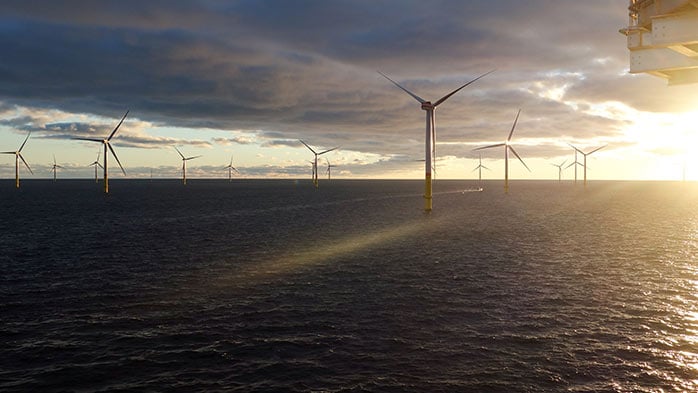
As anticipated, wind generation and its share of power demand both fell in March. However, with forecasts showing above-average wind speeds over the next ten days, we expect wind generation will increase in April, contrary to historical patterns, putting downward pressure on carbon prices. Looking ahead, if wind speeds normalise after ten days, the downward pressure on EUA demand will be modest. However, an extension of strong wind conditions beyond this period would significantly amplify the bearish price pressure.
Hydro power generation in Europe increased in March and, while reservoir levels have dropped, they remain above historical averages. With average precipitation expected and seasonal norms pointing to lower output in April, we forecast hydro generation will decline but still stay above historical levels. Overall, we anticipate hydro output will only have a minimal impact on EUA demand in April.
Subdued power demand expected in April
Power demand decreased in March following US-Iran conflict escalation. Looking ahead, our base case is for the conflict to continue through mid-to-end April, keeping economic outlook subdued. Our forecast for steel profitability – a leading indicator of economic activity – has been upgraded for Q1 but this does not signal an economic recovery, rather a sharp spike in prices driven by panic buying (link accessible by CRU clients, to gain access request a demo here). Based on historical patterns, April typically exhibits lower power demand than March and weather forecasts point to average temperatures next month. Thus, we expect power demand to decrease further. However, given March already saw a significant drop, the decline is expected to be mild.
If power demand holds at current levels relative to historical norms, this will exert downward pressure on EUA demand. Any further weakening would add to the downside.
Potential for gas-to-coal switching
Total fossil generation decreased in March due to weak power demand. Conflict risks – including strikes on Qatari gas infrastructure and reduced traffic through the Strait of Hormuz – have driven a sharp increase in gas prices, leading to significant gas-to-coal switching (n.b. the link is accessible by CRU clients, to gain access request a demo here).
For April, we expect the conflict effects to persist. Both gas and coal prices will rise, with the former rising more steeply, which will sustain the incentive for gas-to-coal switching. However, since significant switching already occurred in March, the additional impact, once again, will be modest.
Consequently, our base case assumes modest gas-to-coal switching for the near term. In a scenario where switching proves stronger, it will exert more upward pressure on EUA demand and, consequently, the carbon price.
Nuclear output will have minimal impact on the carbon price
Nuclear generation declined in March, falling back below historical levels. We expect its output will dip slightly in April and stay below historical levels. No strikes or reactor closures are currently planned. Given no significant deviation from seasonal patterns is expected, we anticipate a limited impact on EUA demand.
If you want to hear more about carbon market forecasts and our short-, medium- or long-term carbon price forecasts, request a demo of our CRU's Energy Transition and Decarbonisation service here.