Policy changes in the USA and the slower progress in renewables expansion in the EU and UK are expected to slow the energy transition. CRU 2025 Steel Long Term Market Outlook revised decarb-related steel demand forecasts in line with those changes.
Energy transition will remain a key driver for steel demand growth in the EU and UK
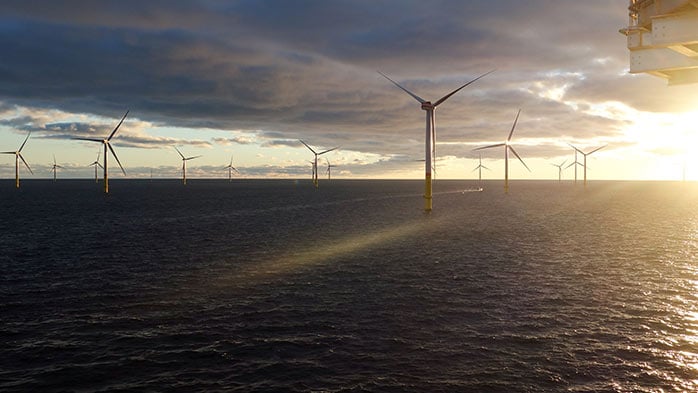
CRU Steel Long Term Market Outlook projects that global steel demand from renewables will significantly increase between 2030 and 2050. The expansion of renewable energy capacity is set to be a major driver of steel demand, particularly in developed economies such as the European Union (EU) and the United Kingdom (UK), as these regions strive to meet ambitious emission reduction targets. The EU’s new Clean Industrial Deal has set a target to install 100 GW of renewable energy capacity annually up to 2030, while the UK has a new plan to double onshore wind capacity and quadruple offshore wind installation by 2030.
CRU projects that the uplift in steel intensity in the EU and UK will be mainly driven by the strong growth in the offshore wind sector, as reversing mill plate demand growth in the long-term is more pronounced in those regions relative to other steel products. See related Insight here (available to CRU clients, if interested, request a demo here.)
However, the transition to renewable energy is now expected to be slower than previously anticipated due to recent policy shifts and market developments. Therefore, CRU 2025 Steel Long Term Market Outlook report has slightly revised down decarbonisation-led steel demand forecasts until 2040 for the EU+UK and North America under both base case and alternative scenarios. Clients subscribed to the Steel Long Term Market Outlook can access the link above. If interested in the service, request a demo here.
However, decarbonisation-led steel demand forecasts for these regions have been revised upwards for the 2040–2050 period. This reflects expectations of a surge in renewables deployment in this decade to offset current delays, with energy transition set to accelerate significantly in this period.
Renewables growth threatened by policy changes in the US
The shift in policy priorities by the new US administration is expected to have impacts on decarbonisation-led steel demand in the country. This is because recent policies announced by President Donald Trump are likely to hinder the construction of renewable energy infrastructure – particularly wind energy.
Soon after taking office on 20 January 2025, President Trump signed an executive order that halted lease sales on federal land and paused the issuance of approvals, permits and loans for wind power projects. As all planned offshore wind turbine projects would be built on ocean expanses that fall under federal jurisdiction, these regulatory changes pose significant downside risks to US offshore wind installation.
In addition to this, on 4 July 2025, Trump signed the One Big Beautiful Bill Act into law. The legislation revises many energy-related tax credits originally established under the Inflation Reduction Act. Under this act, wind and solar projects starting construction after 5 July 2026 will only qualify for production tax credits if they are online by the end of 2027. This will have a substantial impact on the clean energy industry, which relies heavily on these tax credits for project viability; and therefore, many clean energy projects are expected to face delays or might be withdrawn altogether.
In September 2025, the Department of Energy also announced a $625 million investment into revitalising America’s coal industry, and that the $13 billion of unobligated funds that had been allocated for renewable energy projects will be returned to the Treasury.
As a result of these new policies, the anticipated rise in steel intensity from renewables in the USA is now expected to be more gradual, with the increase occurring before 2040 being smaller than previously forecast.
Scaling back of renewables expansion in Europe
CRU’s 2025 Steel Long Term Market Outlook has also slightly downgraded the EU and UK decarbonisation-led steel demand forecasts through to 2040, as the progress of renewables expansion in Europe has been slower than expected.
In the UK, 2019 targets of installing 30 GW of onshore wind and 52 GW of offshore wind capacity by 2030 have been revised downwards in the recent Clean Power 2030 Action Plan to 27–29 GW of onshore and 43–50 GW of offshore wind. Numerous wind projects have also been cancelled or suspended since 2024 across the EU and UK, due to grid limitations, rising costs, and supply chain disruptions.
Notable examples include the UK's Hornsea 4 Offshore Wind Farm in the North Sea and Norfolk Boreas Wind Farm, which were discontinued due to adverse macroeconomic developments, supply chain challenges, and increased market and operational risks. In Germany, although Borkum Riffgrund 3 Wind Farm has been fully installed, critical infrastructure bottlenecks have emerged, preventing grid connection until 2026.
European renewable projects also face regulatory challenges, with several countries experiencing permitting delays that exceed two years. Spain, for instance, was meant to have its offshore wind auction in late 2025 but this has been postponed due to regulatory framework complications.
It is also worth noting that a significant proportion of the demand from the European wind sector is already being met by imports of products such as wind towers from Turkey and China. Therefore, the steel intensity numbers above can be taken as a maximum case, as they can be lower given some demand will be met by imports of downstream products.
Rise of nuclear energy in Europe will reduce steel intensity
Another factor that led us to adjust our steel intensity forecast downwards was the on nuclear power in Europe, as highlighted in the EU’s eighth Nuclear Illustrative Programme. The Programme identified approximately 241 billion in investment needs for nuclear expansion up to 2050, including building new reactors and extending the lifetime of existing reactors. It also recognises the importance of nuclear energy alongside renewables for decarbonisation, industrial competitiveness and security of supply.
While nuclear infrastructure is capital-intensive, it is significantly less steel-intensive than other low emission technologies such as solar and wind, particularly when compared to offshore wind installations.
CRU’s Power Transition Service projects that nuclear electricity generation in the EU27 and UK will rise significantly by 2050. As nuclear captures a larger share of Europe's low-carbon energy mix between 2030 and 2040, the overall steel intensity of the energy transition will be lower than previously forecast.
CRU will continue to closely monitor global decarbonisation developments and will adjust our forecasts as the situation evolves. If you want to know more about long-term steel demand trends, contact us here.