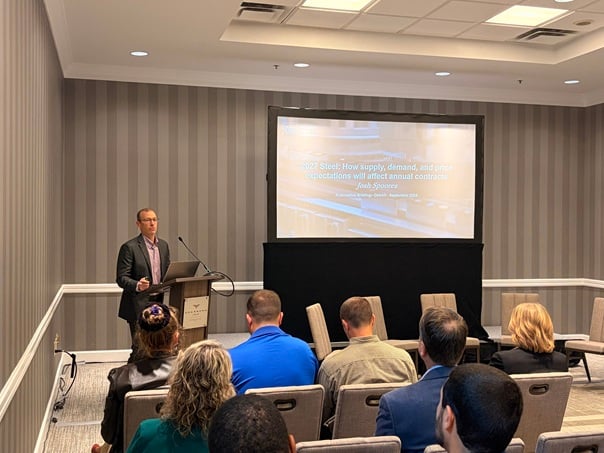
CRU recently attended the OFC 2026 Conference in Los Angeles, California – the premier optical communications event focusing on key market trends such as data centres, AI and high-speed networking. Approximately 16,000 attendees from over 90 countries gathered alongside more than 700 exhibitors. This insight summarises the key market and technology takeaways from conversations with fibre and cable producers, equipment manufacturers, hyperscale data centre representatives, and other industry participants.
Throughout the conference, discussions were focused on shifts toward higher fibre densities per cable while maintaining bandwidth and latency performance. Manufacturers highlighted growing orders for ribbon and intermittently bonded ribbon (IBR) cables ranging from 1,000+ to upwards of 13,000+ fibre counts, as GPU-dense AI racks require exponentially more fibre than conventional deployments. Beyond data centre customers, several producers noted that major US telecom providers are increasingly looking into adopting ribbon cable technologies for their own networks.
With this increased interest, ribbonised fibre availability has come under pressure for US cable producers, mainly due to limited specialised ribbon equipment capacity, which is largely concentrated in Japan. Market feedback indicates lead times for ribbon cables have extended to over a year as hyperscale demand continues to build.
Recent investment and capacity expansions reflect responses in addressing these ongoing demand trends. Fujikura's ¥300 billion commitment for fibre and cable production in Japan and the US – mainly for ribbon and wrapping-tube cables – with a target of up to three times current capacity gives industry participants a degree of optimism around addressing global mid-term demand. While it remains uncertain how much will be invested and when in each geography, market participants are optimistic that these investments will help ease current supply constraints once capacity comes fully online.
Separately, Lightera announced earlier in February that it has opened a second plant at its Mie Works facility in Kameyama, Japan, dedicated to ultra-high-count and multicore optical fibre cable production. This includes mass production of 13,824-count cable, among the highest fibre-density products in the world. Together, these investments signal a significant supply-side response to hyperscale data centre and AI-driven demand, though meaningful new capacity will take time to fully come online.
Apart from the finished product level, collective views from both domestic and international players targeting US customers indicate that the market has entered a phase of sharply rising bare fibre prices. This is particularly acute for A1 (G.652D) and A2 (G.657A1/A2) fibre types, where demand from multiple end-use segments – including data centres, ISP procurement for BEAD-related broadband projects, and more recently specialised defence applications – continues to outpace local preform supply conditions.
US cable manufacturers are largely absorbing higher input costs without significant margin compression, as hyperscale data centre customers exhibit materially lower price sensitivity than traditional telecom buyers. This bifurcated pricing environment, where rising fibre costs can be passed through on data centre orders but not on lower-value telecom contracts, is reinforcing a strategic reorientation across the US cable industry toward higher-margin data centre end-markets.
A shortage of preform and drawing capacity in the US is compelling local cable manufacturers to source bare fibre internationally. This approach allows them to maintain consistent production for data centre clients while still satisfying the strong market preference for US-made finished cables. As a result, their sourcing has shifted to countries with available bare fibre capacity, such as India, Japan and China. By implementing this strategy, cable manufacturers, including top-tier players, have successfully eased pressure on their supply chains.
The combination of preform tightness and Build America Buy America (BABA)-compliance requirements is creating acute allocation pressure around the BEAD program. Some US cable OEMs have deprioritised BEAD projects in the near term, redirecting capacity toward higher margin hyperscale markets. BABA-compliant fibre is largely sold out for 2026, with lead times exceeding 50 weeks versus considerably fewer for non-BABA products, suggesting BEAD deployment timelines may face further delays as fibre allocation continues to favour data centre customers.
CPO fibre demand hinges on on-board architecture choices
A major European fibre and cable equipment manufacturer pointed out that bare fibre demand from co-packaged optics (CPO) relies primarily on the design architecture of the switch ASICs themselves. As highlighted during Coherent’s plenary session presentation, with respect to CPO and scale-up, fibre demand and density will depend heavily on how data centre clusters adopt between two main designs that fall into two main categories: Fast-and-narrow (FaN) and slow-and-wide (SaW).
FaN designs (higher‑rate SerDes, fewer lanes) favour lower fibre counts but higher‑speed optics per link, whereas SaW implementations (more parallel channels at lower speeds) drive higher fibre density and cabling complexity. The chosen balance between lane speed and width determines total transceiver count, connector density and ultimately infrastructure fibre demand within hyperscale AI clusters. CRU expects CPO adoption and related demand to pick up considerably in the later mid-term (2029–2030) period, as larger industry sentiment expects growing adoption around that same time frame as next-gen NVIDIA rack designs, including CPO such as Rubin and Feynman, begin to be deployed.
Hollow-core and multicore presented as next-gen solutions
Hollow core fibre (HCF) was a point of a great attention at OFC, but the tone was still cautious. It is attractive for latency-sensitive applications, especially metro and regional interconnects for data centres. Yet, industry players largely note that HCF remains expensive, harder to manufacture at scale and yields at higher rates versus conventional fibre types. It is also too niche to challenge standard single-mode fibre in the near term.
Multicore fibre (MCF) drew the stronger commercial interest because it looks more usable in today’s network environment, as the technology can deliver more capacity while still fitting into familiar operational models. The recently announced SDM4 MCF MSA agreement with Corning, AFL, Sumitomo, and Terahop is a positive sign for multicore fibre development for commercial applications, with the project to focus on 4-core MCF design for AI data centre campuses – specifically shorter-distance scale out networks using O-band wavelength transmission.
According to discussions with industry leaders, HCF is seeing some current deployment in niche, latency-sensitive metro and regional links, but at low volumes and high cost, limiting it to specialised applications rather than broad substitution for standard fibre types. However, MCF is believed to have a stronger mid-term commercial trajectory due to better testing progress, ecosystem readiness via multicore fan-in/fan-out modules (FIFO), and compatibility with existing architectures, positioning it for more widespread adoption and higher long-term demand growth in AI data centre scale-out compared to HCF.
Progress in FIFO devices was also highlighted at OFC 2026 as central to moving MCF from trials to deployment. Development on modules is still underway for commercial adoption, but if they become low-loss, manufacturable and standardised, they materially improve the business case. Longer term, integrated multicore transceivers may reduce dependence on external FIFO modules, but this remains a future direction. The consensus is that MCF has a better medium-term adoption trajectory than HCF, due to 1:1 conversion compatibility with single-core transceivers/modules and lower cost.
Overall, OFC 2026 confirmed the industry is at an inflection point. AI-driven data centre demand has overtaken traditional telecom as the primary growth engine for optical fibre and cable, creating a seller's market for high-density cable products and pushing bare fibre prices sharply higher. The US market is in its tightest conditions in recent memory, with preform the binding upstream constraint and domestic compliance requirements creating acute allocation pressure. Major capacity investments signal that the supply side is responding, but meaningful relief remains quarters away, and the pace and scale of further preform and fibre capacity commitments will be a key influence on US pricing dynamics as industry players continue to weigh expansion decisions.