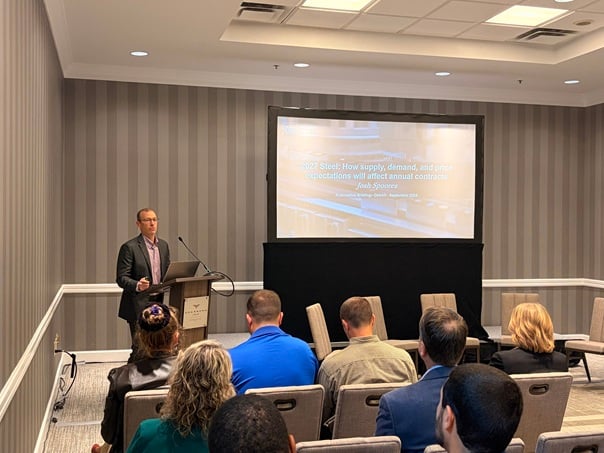
At CRU's London Battery Seminar held last week, our experts in the battery market and key industry leaders gathered to dissect the fast-changing battery landscape. The day was filled with sharp market insights and critical discussions on the future of the entire value chain, from upstream materials to downstream applications.
For those who couldn't attend, we've compiled the essential takeaways from the CRU London Battery Seminar that are set to shape the battery industry in the coming years.
The global automotive shake-up
The electric vehicle race is accelerating. Our experts highlighted a key dynamic: while Chinese carmakers are set to continue their penetration of overseas markets, the industry's legacy Original Equipment Manufacturers (OEMs) are responding by launching new and innovative Battery Electric Vehicle (BEV) platforms of their own. Meanwhile, policymakers have allowed customers to continue buying hybrid vehicles for longer, leaving OEMs to figure out an optimal range of powertrains. This sets the stage for a highly competitive chapter in the automotive sector.
Energy storage: Unlocking new potential
Battery Energy Storage Systems (BESS) are rapidly becoming cheaper and more efficient. This trend is being driven by a combination of supportive policies, advancing technology, and greater economies of scale. In turn, this is unlocking a wave of new demand, creating opportunities for innovative business models, and establishing new regional hotspots for investment and development.
A new era of protectionism and supply chain strategy
In the West, a renewed focus on de-risking and diversifying supply chains is leading to increased protectionism. Our experts at the CRU London Battery Seminar warned that while this strategy aims to build more resilient local industries, significant hurdles remain. Challenges related to cost-competitiveness, lengthy qualification processes, and demanding ramp-up timelines must be overcome to maximise supply chain independence.
LFP chemistry is leading the charge
In the near term, Lithium Iron Phosphate (LFP) is expected to remain the dominant battery chemistry. Its cost-effectiveness and strengthening performance across automotive and energy storage sectors give it a strong market position, though it faces growing competition from advancing nickel-based chemistries that offer higher energy density while using more abundant materials.
The conversation doesn’t end here. If you are navigating the complexities of the battery value chain, you can connect with our experts to continue the CRU London Battery Seminar discussions and gain the insights needed to stay ahead.