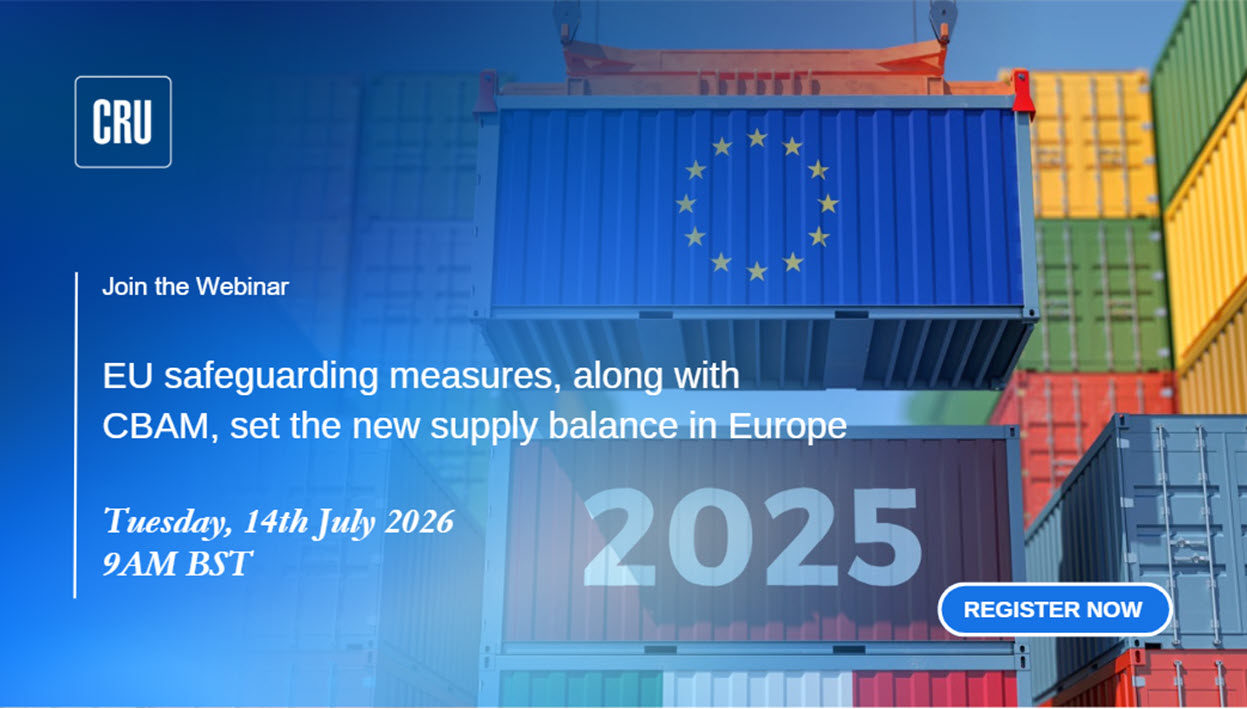
EU safeguarding measures have tightened significantly over the past decade, and the stainless steel sector is no exception. The domestic stainless steel market has been subject to EU safeguarding measures, followed by the introduction of CBAM, stricter safeguards commencing from 1 July 2026, and the introduction of melt & pour regulations.
The lower import quotas, alongside CBAM, are reshaping global stainless trade flows and weighing on import volumes. From July 2026, European cold rolled coil quotas will be cut by 53%, placing further pressure on the already-subdued CRC import volumes in 2026 H1. The introduction of melt & pour regulations poses significant risks for Asian exporters reliant on third-country steel feed.
Estimating the new EU safeguarding measures for individual exporting countries
As part of the Steel and Metals Action Plan, the European Commission (EC) has announced new quotas for stainless imports, reducing stainless safeguarding quotas by 53–65% across key flat stainless products (see also our Insight titled New EU safeguard quotas will re-shape global stainless trade flows). The total volume of safeguarding quotas has been calculated by applying the market share of imports into the European Union (EU) market in 2013 as a reference, although the regulator has provided no detailed breakdown for each exporting country.
The new European safeguarding measures will be "based on the share of imports that each product category held over the period 2022–2024". We calculated individual stainless CRC safeguarding quotas for key exporting countries based on 2022–2024 imports from these countries into the EU. The size of new quotas is close to the ones we previously calculated using 2025 H2–2026 H1 quotas on a pro-rata basis.
The new CRC safeguarding quota for China is the second highest at 84 kt, although the previous safeguarding quotas (2025–2026) included no individual Chinese CRC quota, resulting in reduced CRC safeguarding quotas for other countries. It is also worth noting that the new CRC quota for the USA at 7 kt came in significantly below the quota calculated based on the previous 2025–2026 allocation. This is due to a significant reduction in exports from the USA to Europe, reflecting much stronger US stainless steel prices during 2022–2024.
New quotas set to weigh on CRC imports
The new quotas will deliver a significant 53% reduction in European cold rolled coil quotas and, alongside CBAM, this is placing further pressure on CRC imports, which were already down 50% y/y in the first four months of 2026, according to GTT data. CRU estimates that, at this rate, CRC imports in 2026 will marginally exceed the new 493 kt import quota by approximately 18 kt, or around 4%. It is noteworthy that the new EU safeguarding measures alone would represent a material tightening of import conditions, even in the absence of CBAM.
The introduction of melt & pour regulations
As part of the new regulations, the EC introduced the ‘melt and pour’ principle. This defines steel origin as the country where it was first melted and cast into its initial solid form. Under Article 3 of the new regulation, importers must provide documentary evidence, such as a mill certificate from the original steel producer, containing the technical and production data necessary to trace the origin of steel at the point of importing it.
This marks a deliberate departure from conventional origin rules, which could be satisfied by sufficient processing or transformation in a third country. The introduction of melt & pour regulations was designed to close circumvention loopholes where steel is melted in one country but routed through another, with minimal further processing.
On 4 June 2026, the EC launched a targeted consultation on the documentary evidence importers will need to provide to prove the country of 'melt and pour'. Running for four weeks until 2 July 2026, the consultation invites input from across the steel value chain – including producers, consumers, traders, importers and industry associations – to identify the most practical and reliable documentation for verifying where imported steel was originally melted and cast. The Commission will review the responses as it prepares the implementing act, which is expected to be adopted by 31 August 2026 and to enter into force on 1 October 2026. Looking further ahead, from 1 October 2027, the Commission will begin drawing on the melt-and-pour information gathered from importers, before assessing in July 2028 whether 'melt and pour' should become the permanent basis for quota allocation.
Trade exposure: CRC exporting countries most at risk
The sharpest impact of the ‘melt and pour’ rule falls on countries that process steel melted elsewhere rather than producing their own. Turkey, Vietnam, Thailand and Malaysia rely entirely on imported stainless slab and hot-rolled coil to feed downstream rolling and re-export as they lack domestic melt capacity of their own.
Even Taiwan (China), despite having some melt capacity, remains materially dependent on Indonesian feed (>80% of total imports of stainless slab and HRC comes from Indonesia). The EU has already extended anti-dumping duties to stainless steel routed via Taiwan (China) and Vietnam, with Turkey scrutinised in the same case. By fixing origin at the furnace, the rule removes the processing-country shield, counting steel against the quota of where it was truly melted, not merely shipped from.
The introduction of melt & pour regulagions marks the most structurally significant shift in EU steel import regulation in a decade. For the stainless sector, characterised by complex, multi-country supply chains, its implications are far-reaching. With the evidentiary obligation taking effect from 1 October 2026 and a potential permanent shift to ‘melt and pour’ quota allocation on the horizon by 2028, the window for supply chain review and compliance preparation is narrow. Importers, producers and traders would be well-advised to act now.
Although European regulators have made no direct comments on how the "melt and pour" principle will be applied, we expect rolled stainless exports from countries with no crude stainless production to come under pressure. Our analysis indicates that Malaysia and Turkey will have the highest share of their respective CRC production exported to the EU, with Turkey accounting for the highest tonnage of exports to the EU.
For readers interested in analysis of how the recent regulatory actions influence the global stainless trade, feel free to request a demo here. If you want to hear more about our work on regulations in the stainless market, you can also get in touch with us – we’ll be happy to answer your questions.