The brutal November base-metals selloff may not be over, but investors and producers can take solace in an outlook for critical metals that remains positive. Physical-market signals suggest headline price moves are obscuring very different conditions across copper, aluminium and nickel.
LME three-month copper fell $176.50 to $11,649.50/t on 25 November, aluminium dropped $18 to $2,751/t, while nickel was up $3 to $15,169/t. Copper is at its lowest in almost a year and is 21% off its record high of $14,812 /t on 9 September. Aluminium’s cash-to-three-month backwardation widened to a 36-year high of $367.5 /t this week before narrowing sharply on 25 November. Nickel has registered the largest year-to-date decline of all LME metals, falling by about 9% since 2 January.
Copper’s slide contrasts with record Chinese premiums, while aluminium prices have slumped despite extreme near-term tightness. Nickel presents a different picture, with ample supply keeping its forward curve firmly in contango.
The metals rout has multiple roots. The US-Israeli war on Iran that began at the end of February has driven oil and natural-gas costs higher and reversed expectations of rate cuts by the US Federal Reserve. At the same time, there are increasing concerns over AI infrastructure spending, exacerbated by the scandal that forced the departure of Nvidia’s Chief Executive Officer Jensen Huang and his dramatic reinstatement on 23 November. The long-looming threat of copper tariffs has drawn significant imports into the US over the last two years, tightening supplies in other parts of the world, with the US now poised to export back into the global market. Economic data from China has also weighed on market sentiment.
Copper
Copper prices have fallen almost 15% over the past two weeks, with LME three-month copper near a one-year low on 25 November from $13,890/t on 9 November. COMEX is down to about $5.43/lb from about $6.36/lb, also a one-year low. Over the same period, physical premiums in China rose to record levels.
The drop has been linked to fading enthusiasm for copper as an AI-related investment, a lower chance of US tariffs on refined copper, a stronger US dollar and selling by investment funds.
CRU VIEW
Copper prices could remain under pressure in the near term, but the medium-term outlook remains constructive. Investors unwinding speculative positions as confidence in AI-related spending weakened has contributed to the recent decline.
Sentiment could remain a source of downward pressure until the mood surrounding AI-related investment finds a floor and positioning adjusts. Over the medium term, the structural challenges facing mine supply remain unresolved and should continue to support prices.
CRU sees the contrast between falling prices and rising Chinese premiums as a gap between financial market sentiment and how much metal is available.
Chinese visible stocks are estimated at around 54,000 t, which pushed premiums for LME-registered cathode to around $500–600/t CIF Shanghai. We expect this tightness to ease in the first quarter of 2027. Some 50,000–100,000 t of copper from the US is expected to arrive in Asia in January, and Chinese stocks typically build by about 300,000 t during that period.
Whether or not tariffs are introduced, high US stock levels and stronger demand-pull from China could slow shipments to the US. This should leave more refined copper available outside the US, particularly in Asia, although the timing depends on the US tariff position.
Lower copper and sulphuric acid prices are adding to the pressure on smelters' margins. CRU expects this to lead to more meaningful cuts in smelter output in 2027. Our outlook for Chinese demand remains positive, with refined consumption forecast to grow by 4.1% in 2027. Although smelter-to-trader TCRCs have risen in recent weeks, miner-to-trader TCRCs hit a record low of -$322 this week, suggesting that concentrate available to miners remains tight and will continue to be tight in the near term.
Futures markets are broadly consistent with our view that current tightness will ease over time. The SHFE forward curve remains in backwardation into early 2027, reflecting near-term market tightness, but then flattens further along the curve. The LME forward curve is broadly flat, suggesting little conviction around the direction of prices at present. By contrast, COMEX remains in contango, reflecting expectations around potential tariffs and the large stockpile of copper already held in the US.
Aluminium
Aluminium prices have also come under significant downward pressure over the past two weeks, with the LME three-month aluminium price declining almost 11% from about $3,098/t on 9 November. Under the same macro backdrop, Aluminium has been dragged lower in copper’s slipstream.
CRU VIEW
The plunge has highlighted an increasingly clear split between current fundamentals in the aluminium market and expectations for 2027. The prospects for a large surplus are increasingly clear and arguably behind the price weakness. Cash prices have been much stronger for most of this period leading to the widest cash to three-month backwardation for aluminium since the late 1980s.
Over the same period, European and Asian spot premiums have slumped as the extreme LME backwardation encourages inventory liquidation. The Japanese spot premium fell by $80/t w/w in CRU’s most recent assessment, while the European duty-paid premium slipped to $389/t on 24 November from $571/t on 9 November. Lower LME prices have reduced US Midwest premiums through lower tariff costs.
The slide in LME aluminium prices have has been exacerbated by news the LME is about to list Indonesian producer Huaqing Aluminium Morowali among its authorised deliverable brands.
This also highlights the key reason we are bearish for 2027, namely that rising supply will become available to the global market as we are set to see – by far – the fastest growth in World ex. China supply in any year. This will be fuelled by a combination of a more than doubling in Indonesian output and rebound in middle Eastern output.
Nickel
The forward curve for nickel has not changed significantly over the past month with contango throughout forward dates, which is normal and reflects the cost of carrying material with no expectations there will be insufficient metal available going forward.
The cash-to-three-month contango has been steady over the past month averaging around $200/t. The lack of change illustrates little has altered in investors’ positioning in terms of the net long position of investment funds.
CRU VIEW
The contango reflects sufficient availability of nickel with growth in supply from Asia. There are no concerns over a potential deficit on the horizon. Fundamentally, the market is well-supplied with another surplus in class 1.
Over the past month the price has traded mostly in the $15,500-16,500 /t range as slowing demand has been balanced by prospects of supply cuts in Indonesia. Still, the price decline to $15,166/t at the time of writing may be a little overdone given that some of the HPAL capacity in Indonesia would be losing money if producers are paying spot-sulphur prices.
Speculation around potential coordinated output cuts by Chinese producers in Indonesia’s industrial parks circulated among market participants throughout October. Figures of 20% cuts in NPI and 50% in MHP production were mentioned as a reaction to the El Niño-induced drought and broader market conditions, providing some support to nickel prices.
Chinese stainless production has been steady but subdued. While overall production is understood to be down y/y in October, output of 300 series maintained growth, helped by the favourable spread seen relative to lower nickel prices. Chinese battery precursor production remained steady, although weak domestic EV demand is likely to result in lower order levels in Q4.
In short, the base metals sell-off is broad; the fundamentals are not. Copper’s supply constraints remain supportive, while aluminium and nickel face surplus pressures they are vital energy transition metals – a reminder that sentiment alone cannot tell the whole story.
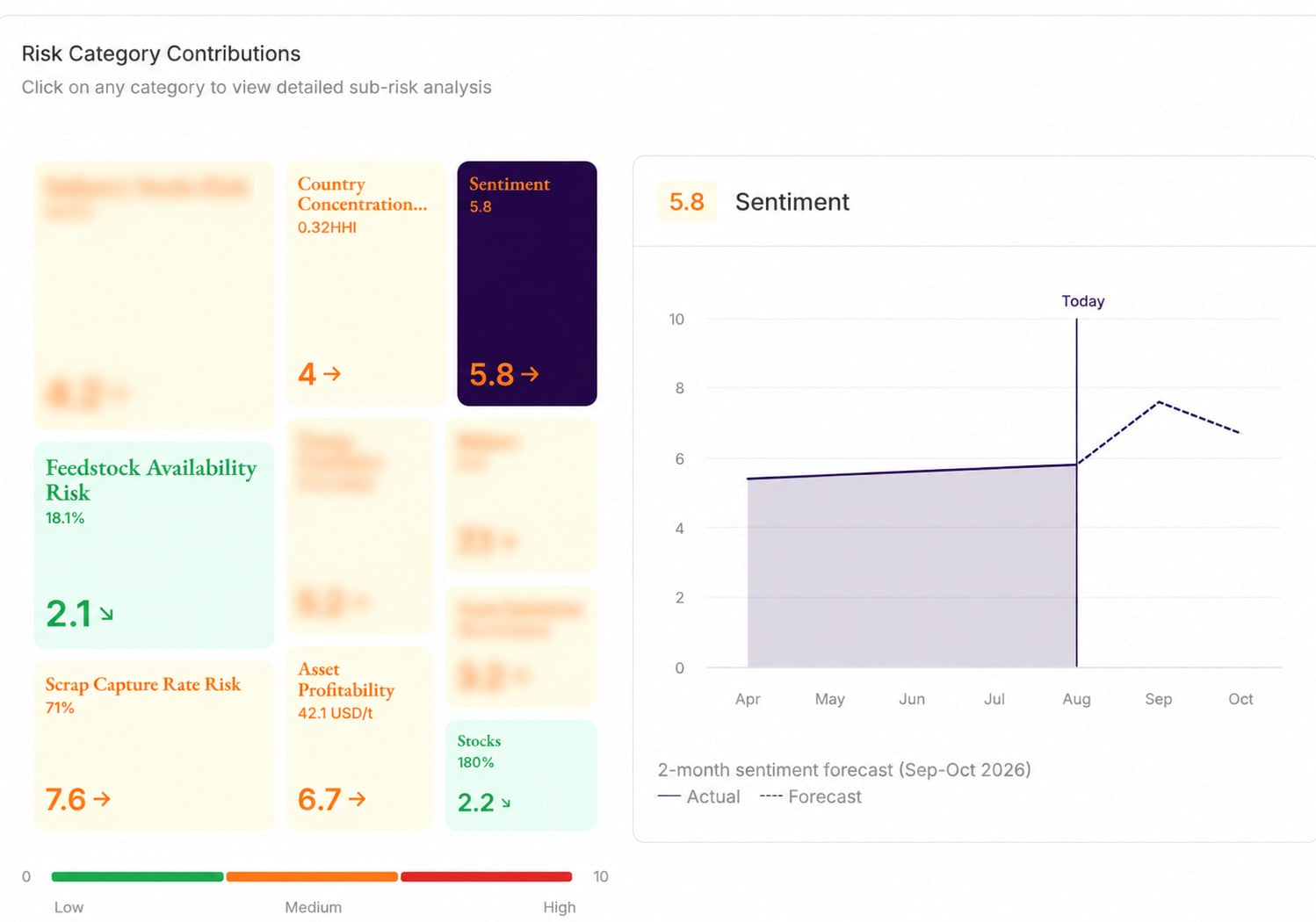
Big corrections in commodity markets are not new but there is always an element of surprise to them. In hindsight, the factors that have led to this correction were known risks. In an increasingly dynamic and uncertain world, market participants need the right tools to navigate risks.
© CRU. All rights reserved. This content may not be copied, reproduced, republished, distributed, or otherwise used, in whole or in part, without CRU’s prior written permission. Please refer to CRU's Terms and Conditions.