Put Commodity Market Context into Financial Planning
Commodity price risk matters to finance and business controlling teams because market changes can affect input costs, margins and planning assumptions. Reviewing raw material prices alongside broader market developments can provide useful context for internal analysis and discussions.
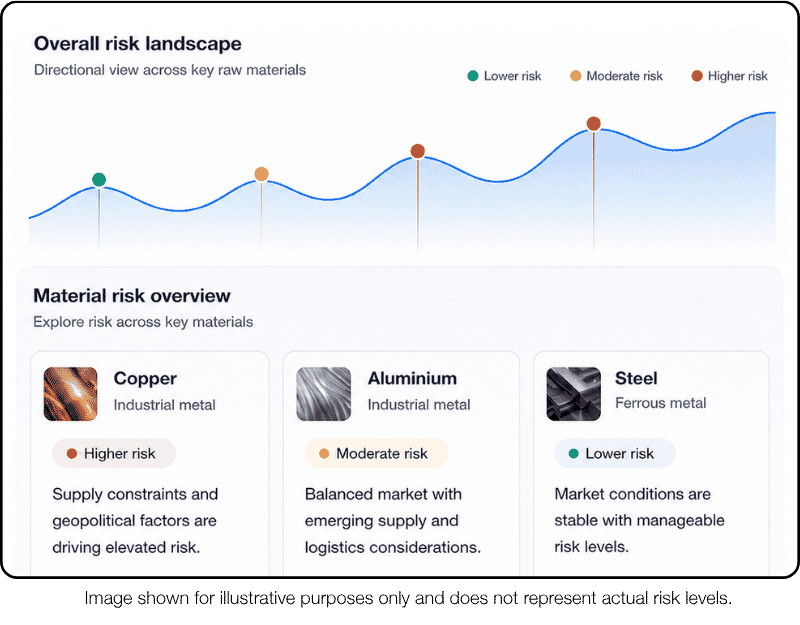
The CRU Risk Navigator gives you a view of changing supply and price risk, the drivers behind it, and how risk is changing over time. It currently covers copper, aluminium and steel, with more commodities to follow. Commodity price forecasts can add useful market context to planning discussions alongside your own assumptions.
The Story Behind CRU Risk Navigator
CRU Risk Navigator was developed in response to a challenge we repeatedly heard from the market: understanding risk is often less about finding information and more about knowing what matters.
In this video, Matthew Perlman, Product Owner of CRU Risk Navigator and Senior Innovation Manager at CRU, reflects on the customer needs and market observations that helped shape the platform.
Understand the Product
Get a concise overview of the CRU Risk Navigator, its coverage and how it brings CRU intelligence together to show changing supply and price risk.
Understand Price Risk, Supply Risk and the Methodology
Commodity price risk is distinct from supply risk, though both can be relevant to business planning. Understanding commodity price volatility and the drivers behind changing market conditions can help finance teams frame analysis and internal discussions.
The CRU Risk Navigator applies CRU’s connected commodity intelligence to changing supply and price risk. It provides a view of changing supply and price risk across copper, aluminium and steel.
Request a demo to explore how the score works, what it represents and what is driving the risk view.
Connect Market Context to Finance Workflows
Commodity price risk can be considered alongside planning assumptions, margin analysis and leadership reporting. Reviewing raw-material prices and relevant market drivers can add external commodity context to your finance and business-controlling workflows.
The CRU Risk Navigator can support finance and business-controlling teams as they bring a consistent commodity-risk view into commercial planning. Finance and operational teams can work from the same independent, evidence-based view of market risk in their discussions, while applying their own internal analysis to assess business-specific exposure The view can support leadership updates and help teams prepare for commodity-risk questions, alongside existing financial models, reports and market updates.
Support Leadership Conversations about Cost and Margin
Commodity price risk can be relevant to leadership discussions about cost, margin, planning and supply continuity. A commodity price forecast can provide market context to consider alongside internal assumptions and analysis; it does not determine the organisation’s financial exposure.
The CRU Risk Navigator provides an external view of supply and price risk and its drivers that finance leaders can consider alongside business priorities. Its methodology and scope can be reviewed as part of assessing fit with existing CRU content and workflows. This can support discussions with CFOs, leadership teams and boards, without claiming quantified savings, return on investment or automated exposure measurement.
Request an Executive Briefing >
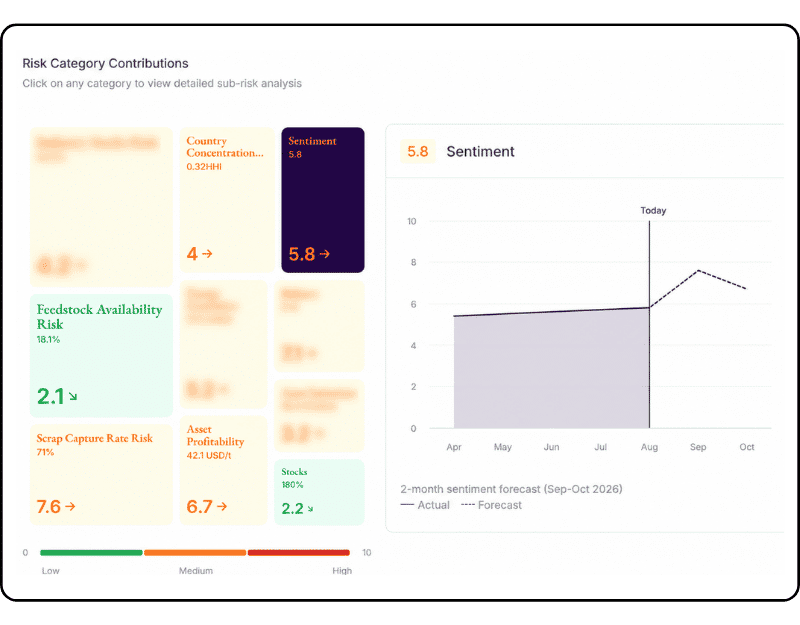
Make Your Next Market Update More Defensible
Use commodity price risk context from CRU Risk Navigator to examine market drivers and support informed planning and leadership discussions.
Why Choose CRU?
The CRU Risk Navigator brings our connected commodity intelligence into a structured view of changing raw-material risk. See how CRU’s approach, data, insight and communities can support a deeper understanding of the markets that matter to your business.
Our Approach
Learn More
Prices and Indices
Learn More
Supply and Demand
Learn More
Forecasts and Scenarios
Learn More
Asset Data: Supply, Costs, Emissions and Valuations
Learn More