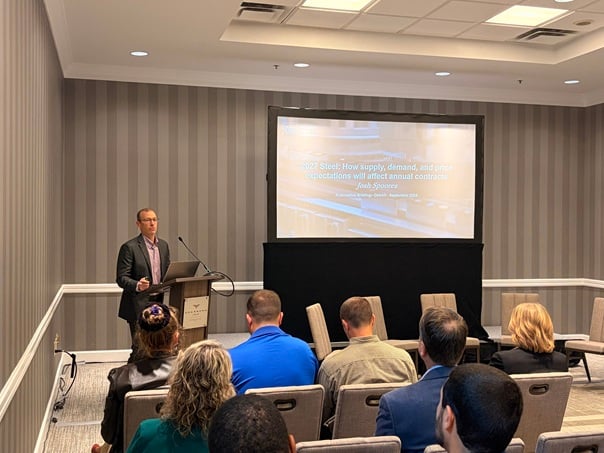
CRU attended Fiber Connect 2026 in Orlando as a Media & Analyst partner, where the event highlighted a fibre market moving beyond fibre-to-the-home (FTTH)-led growth into a broader phase of structural demand expansion driven by AI, hyperscale and edge data centres, cloud interconnection, and emerging quantum networking. A key theme was that optical fibre is no longer viewed simply as a broadband delivery medium, but increasingly as critical infrastructure underpinning latency-sensitive, synchronised and distributed computing, positioning fibre as a strategic backbone of the emerging digital economy.
AI is the primary catalyst for US fibre network expansion
The rapid growth of AI infrastructure is placing unprecedented demands on physical fibre networks. Major hyperscalers – including Microsoft, Amazon, Google and Meta – are collectively investing approximately $370 billion annually in AI infrastructure, with Meta recently announcing a $600 billion multi-year initiative. This massive expansion is necessary because AI factories depend on tightly synchronised, latency-sensitive fabrics that span regions and distributed inference environments.
Data centre pressures and optical scaling challenges rise
The conference also reinforced that optical connectivity is becoming one of the primary factors on data centre scaling. The issue is no longer limited to raw network capacity, but increasingly includes optical reliability, transceiver performance and the challenge of scaling from 400G to 800G, and eventually 1.6T, while maintaining power efficiency and system stability at large volumes.
Several discussions emphasised the growing importance of low-latency optics, especially in AI environments where tightly coupled systems depend on highly efficient interconnect performance. Co-packaged optics, linear pluggable optics, hollow core and multicore fibres were discussed as part of the next phase of market development, but the broader message was that vendors must simultaneously improve performance, reliability and energy efficiency. This raises the bar for cable, connector and interconnect product design throughout the ecosystem.
Additionally, power availability has emerged as a dominant constraint, with lead times for lighting up new fibre networks in some regions doubling to over 180 days. This energy scarcity is forcing a shift toward distributed, smaller-scale data centres built closer to the end user and local distribution network, to better manage local power sourcing.
Product showcases focus on density and easy deployment
On the product side, the strongest trend was toward higher-density, easier-to-deploy and more scalable optical solutions. Exhibitors and speakers repeatedly highlighted multicore fibre, hollow-core fibre, micro cable, pre-connectorised architectures, plug-and-play deployment systems, next-generation connectors and FTTH hardware designed to reduce field labour and accelerate installation timelines.
Examples include the following:
- STL is highlighting multicore fibre, hollow-core fibre, pre-connectorised architecture and aerial fibre distribution hub (FDH) gear for FTTH builds.
- Corning showcased multicore fibre, micro cable, next-generation connectors and related AI/data-centre-oriented fibre and connectivity technologies.
- Sumitomo Electric Lightwave is focusing on its Quantum-Ultra Fusion Splicer, 32 Fiber MMC Connector and broader fibre-optic product sets.
- CommScope had shown its FTTH-focused fibre ecosystem, with an immersive solutions wall that walks attendees through the network from headend to premises, including distribution hubs, closures, terminals, drops and MDU/SFU deployments. The company also highlighted its XPND (“Expand”) fibre platform for higher-capacity broadband networks.
Taken together, the event’s emphasis on higher-density fibre designs, pre-connectorisation and faster installation workflows suggests vendors are addressing some of the most immediate pressures facing telcos. These measures include controlling deployment costs, reducing dependence on scarce field labour, accelerating FTTH and backbone roll-outs and providing reassurance of continued support for traditional telecom network builds.
Edge networks and middle mile become primary focuses
Another major takeaway from Fiber Connect 2026 was the increasing strategic importance of data centre and edge compute interconnect. As AI inference expands and more data processing shifts closer to end users, networks are expected to carry more east-west traffic between data centres, regional nodes and edge locations. As a result, the middle mile is likely to require more route diversity, redundancy and fibre intensity than in the past.
The event suggested that the industry is moving away from a sequential network-upgrade model and toward a more integrated approach in which core, middle-mile, edge and access layers all need to be strengthened in parallel. As a growing share of data is created and consumed at the edge, disrupted infrastructure and its relative higher fibre demand becomes relevant, increasing demand for distributed infrastructure and more fibre-connected optical devices.
Interest in quantum computing starts to take shape
The sessions made it clear that quantum technologies are beginning to move from theory toward practical infrastructure planning, and that fibre is essential to this transition. Rather than replacing classical systems, quantum capabilities are expected to be layered on top of existing fibre backbones through secure communications, precision timing, synchronization, and distributed compute applications.
Examples highlighted at the event included the state of Florida’s agreement to deploy the first fully quantum-secured fibre network in the United States and the Electric Power Board of Chattanooga (EPB) in Chattanooga’s commercial quantum network. Interest in this area is also being shaped by concern over “Q-Day,” the point at which quantum computing could potentially compromise current encryption standards. Even so, participants stressed that workforce readiness, university partnerships, and specialised photonics expertise will be critical to progress.
The growing imperative for FTTH networks in the US
Beyond the demands being created in hyperscale and interconnection networks, these broader capacity requirements are also reinforcing the case for FTTH deployment in access networks. The US has recently surpassed the milestone of 100 million homes passed with fibre, marking over 60% of household coverage, yet the pressure to continue upgrading legacy systems remains intense.
A recent white paper by the FBA suggests that the business case for cable operators (MSOs) to migrate from Hybrid Fiber-Coaxial (HFC) to Fiber-to-the-Premises (FTTP) is strengthening due to economic realities. Specifically, FTTP operational expenses are approximately 50% lower than those of maintenance-intensive HFC networks. Furthermore, the capital expenditure required for full HFC overhauls, such as DOCSIS 4.0, is becoming comparable to that of ground-up fibre rebuilds, making full-fibre infrastructure an increasingly inevitable long-term roadmap to meet predicted demand for 1 Tbit/s speeds by 2040.
Despite strong demand for fibre expansion, deployment in the United States continues to be constrained by a combination of permitting delays, material supply issues and labour shortages. Permitting was identified as the single largest barrier, particularly for long-haul projects that may need approval from more than 100 separate administrations, while Broadband Equity, Access, and Deployment (BEAD)-funded builds are also being affected by the high cost and limited availability of glass for fibre cables.
At the same time, labour availability is becoming a critical challenge, with the industry estimated to need an additional 200,000 to 250,000 workers by 2029. This pressure is being intensified by hyperscalers drawing skilled workers away from traditional telecom roles, making workforce development through university partnerships, vocational training and targeted programmes an increasingly strategic priority.
Main takeaways from Fiber Connect 2026
The overarching conclusion from Fiber Connect 2026 is that optical fibre and cable industry is moving into a broader, more complex growth phase, driven not just by consumer broadband but also by AI infrastructure, hyperscale interconnection, data centre expansion, edge computing, middle-mile upgrades and quantum preparedness. As a result, commercial success is increasingly determined not only by transmission capacity, but also by speed of deployment, space efficiency, labour and power savings, and resilience amid permitting, workforce, energy and supply chain constraints.